
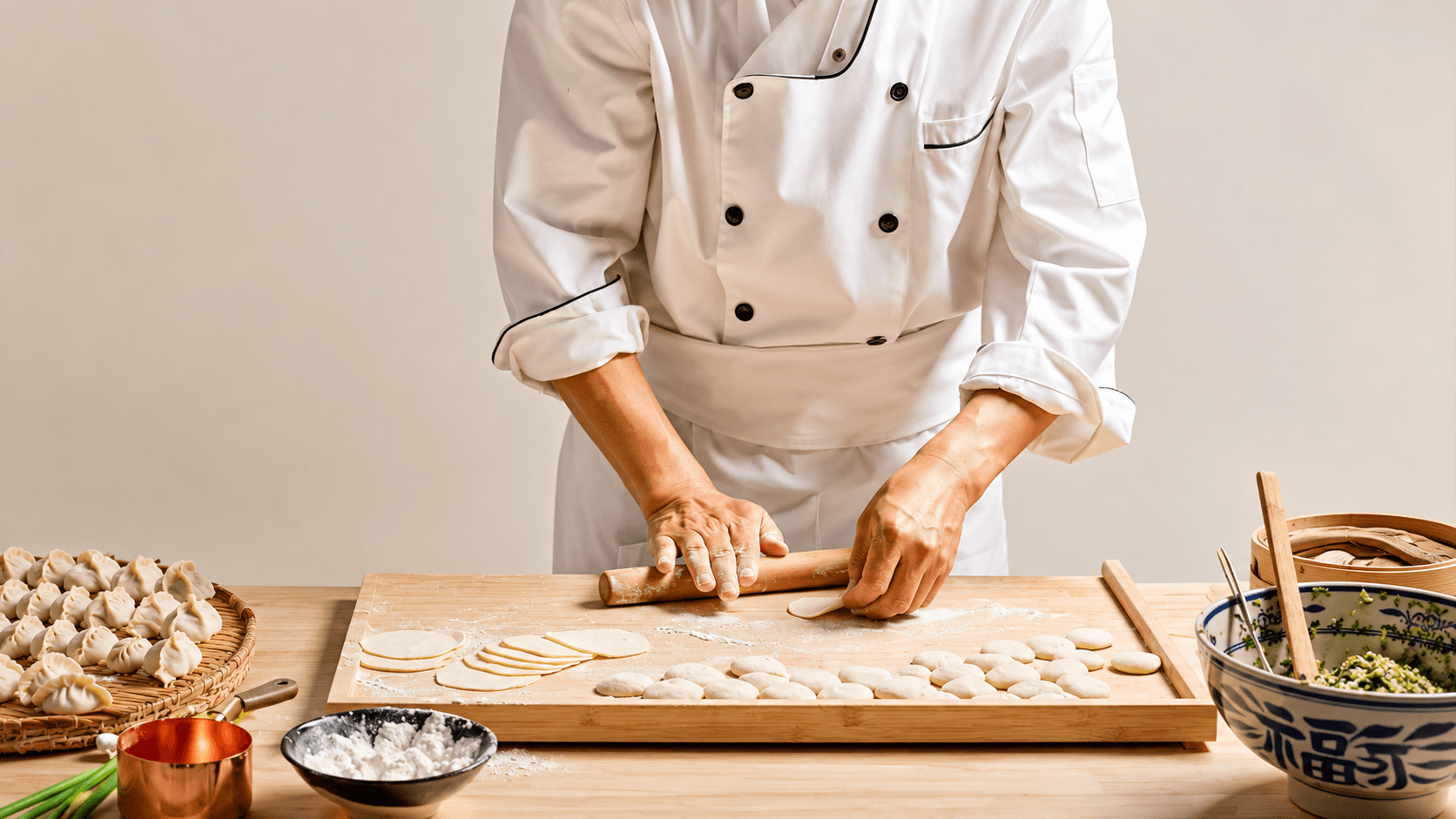
Wrapper Thickness Is the Real Difference Between Hand-Wrapped and Machine-Made Dim Sum
Buyers evaluating a new dim sum supplier usually start with price and MOQ. Those matter, but they’re not what actually determines whether a product tastes premium or tastes mass-produced. That comes down to something much smaller and much easier to overlook: the thickness of the wrapper, and how evenly — or unevenly — it’s controlled.
This sounds like a minor detail. It isn’t. It’s the single biggest reason a hand-wrapped siu mai and a fully automated one can use the same filling and still taste like two different products.
What Skilled Hands Actually Do Differently
A trained dim sum chef doesn’t roll a wrapper to a single uniform thickness. They roll it thinner in the center and leave slightly more thickness at the edge, where the seal has to hold the filling and survive steaming without splitting. That’s not inconsistency — it’s a deliberate, controlled variation that a machine roller, by design, doesn’t produce. A roller sets a gap and the sheet comes out at that gap’s thickness, edge to edge, uniformly.
That uniformity sounds like a good thing until you think about what it forces as a trade-off. Set the roller gap thin enough to get the tender, almost-translucent bite you want in the center, and the edges — which need more structural strength to hold a pleated seal — become the weak point, more prone to splitting during steaming. Set the gap thick enough to keep the edges reliable at scale, and the center of the wrapper turns doughy and chewy in a way that reads as “frozen food” rather than “made by hand.”
This is also why texture, not filling recipe, is usually the first thing that gives away whether a product was hand-wrapped. The filling can be identical. The wrapper is where the difference shows up.
Where Machine Production Genuinely Wins
It’s worth being straightforward about this rather than pretending machines are simply worse. For high-volume, price-sensitive SKUs — the kind sold at large retail scale where consistency across millions of units matters more than the last 10% of mouthfeel refinement — machine-rolled wrappers are the right tool. They deliver dependable uniformity, lower cost per unit, and throughput that no hand-wrapping team can match. A private label brand building a value-tier SKU for mass retail distribution is usually better served by a well-calibrated machine line than by trying to hand-wrap at a volume where quality control becomes the bottleneck.
The mistake is applying that same logic to a premium SKU, where the wrapper’s texture is exactly what a discerning buyer — or their end customer — is paying more for.
Why This Is Where an Experienced Chef Team Actually Matters
This is also where a manufacturer’s kitchen leadership matters more than its equipment list. Our dim sum production is led by chefs with over 20 years of five-star Cantonese hotel and restaurant experience — the kind of background where a siu mai wrapper rolled a fraction of a millimeter too thick, or a fold placed slightly wrong, was never something that made it out of the kitchen.
That experience shows up in two different places in our production, not just one. On fully hand-wrapped premium lines, it’s direct — the same techniques used in five-star hotel dim sum kitchens, applied at OEM scale. On higher-volume lines where machine rolling is the right call for cost and throughput, it shows up differently: our chefs are the ones setting and calibrating the parameters — dough hydration, roller gap, resting time, filling-to-wrapper ratio — so the machine-made product gets as close as physically possible to a hand-wrapped mouthfeel, instead of a generic factory setting borrowed from whatever the equipment manufacturer’s default recipe happens to be.
That distinction — chef-calibrated machine production versus off-the-shelf machine settings — is usually invisible on a spec sheet, but it’s very much not invisible when the product is steamed.
How to Actually Check This as a Buyer
Claims about “handmade” and “premium” are cheap to make and hard to verify from a sales deck. A few things worth asking for instead:
- Wrapper thickness tolerance data, not just a general description. A manufacturer that’s actually controlling this will have real numbers, not an adjective.
- Whether the recipe and process were developed or calibrated by someone with hospitality or hotel kitchen experience — this tends to correlate strongly with attention to texture details that a purely industrial food science background doesn’t always prioritize.
- Photos or video of the product actually steamed, not just raw or packaged. Translucency, pleat definition, and whether the wrapper holds its shape are far more telling than a marketing photo of raw product on a tray.
- A side-by-side sample of the hand-wrapped and machine-made version of the same SKU, if both exist. The difference should be obvious in a blind taste test — if a supplier is reluctant to provide both, that’s worth noting.
- Realistic production capacity numbers for the hand-wrapped line. If a supplier claims unlimited volume at hand-wrapped quality and hand-wrapped pricing, the math doesn’t usually work — hand-wrapping has a real throughput ceiling, and that ceiling is part of what makes it premium in the first place.
Matching the Production Method to the Product Tier
Not every SKU in a product line needs to be hand-wrapped, and treating every product as if it does usually just inflates cost without a corresponding gain the end customer will notice. A useful way to think about it:
- Flagship or premium-positioned SKUs — the ones a brand is using to establish a quality reputation — are where hand-wrapping, or at minimum chef-calibrated machine production tuned specifically for texture, earns its cost.
- Volume or value-tier SKUs — where price point and consistency across huge batches matter more than nuanced texture — are usually better served by standard machine production, and trying to hand-wrap at that volume tends to create quality control problems rather than solve them.
A manufacturer that can genuinely do both, and can explain clearly which of your SKUs should go which direction, is a more useful partner than one that either hand-waves “everything is handmade” or defaults everything to machine production regardless of positioning.
Building a premium dim sum line and trying to figure out which SKUs actually need hand-wrapping versus chef-calibrated machine production?
Tell the Dong Dimsum team about your product positioning and target price point, and we can walk through what the right production approach looks like for each SKU — including samples so you can taste the difference yourself.
Talk to Our Dim Sum Production Team
Frequently Asked Questions
Is hand-wrapped dim sum always better than machine-made?
Not universally — it depends on the product’s positioning. For premium SKUs where texture is part of what the customer is paying for, hand-wrapping or chef-calibrated machine production makes a real difference. For high-volume, value-tier products, well-calibrated machine production is usually the more sensible choice, and the texture gap matters less at that price point.
What should I actually look at to tell if a wrapper was made well, hand or machine?
Steam a sample and look at translucency, whether the pleats hold their shape, and whether the wrapper is thin in the center without splitting at the edges. Thickness tolerance data from the manufacturer is more reliable than a description on a spec sheet.
Can machine-made dim sum get close to hand-wrapped texture?
Yes, to a meaningful degree, if the machine parameters — dough hydration, roller gap, resting time — are calibrated by someone who understands what hand-wrapping achieves and why, rather than left at generic equipment defaults. It won’t fully replicate the deliberate thickness variation a skilled hand achieves, but a well-calibrated machine line can get considerably closer than an uncalibrated one.
Why does a manufacturer’s chef background matter if I’m just buying a finished product?
Because the wrapper’s texture — thickness, translucency, how it holds up during steaming — is set during recipe and process development, not something that can be corrected later. A team with real hotel or restaurant dim sum experience tends to catch texture issues that a purely industrial production background may not prioritize.
Should every SKU in my product line be hand-wrapped?
Usually not. Hand-wrapping has a real cost and throughput ceiling, which is part of what makes it appropriate for premium, reputation-building SKUs. Applying it to every SKU in a line, including value-tier products, typically raises cost without a difference the end customer at that price point will notice.